

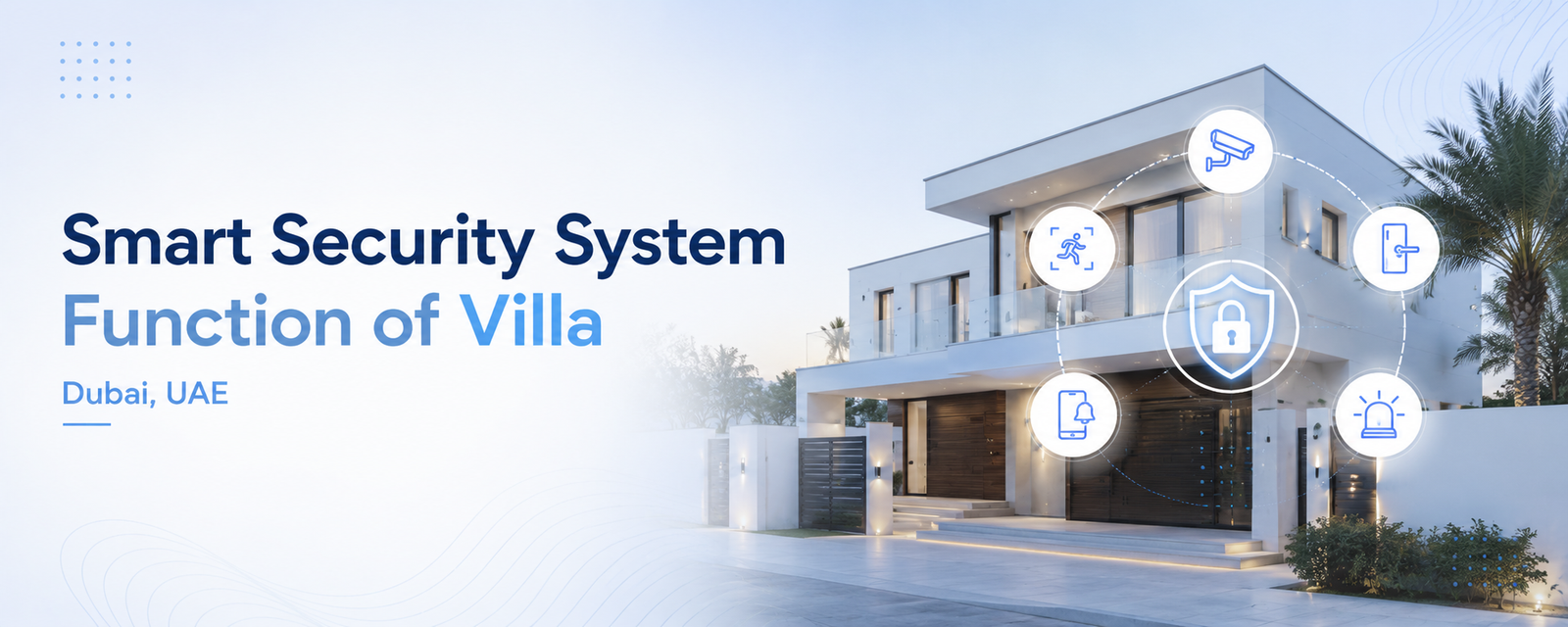
A smart villa security system functions by tying perimeter sensors, cameras, door and window contacts, motion detectors, and gate automation into one monitored network — controlled from a single app instead of five disconnected ones. That integration is the entire point. A villa in Arabian Ranches or Al Barari has a garden, a driveway gate, side entrances and sometimes a staff quarter that a Marina apartment simply doesn’t, and each of those becomes a gap if it’s wired as a separate, unlinked device rather than part of one system.
I’ve spec’d and fitted enough of these systems across Dubai villa communities to know where the theory and the actual property layout stop agreeing with each other. This breaks the system down zone by zone, plus where UAE-specific rules — SIRA compliance, developer approval, Dubai Police integration — actually change what gets installed.
| On this page |
Every sensor, camera and lock in the system reports back to a central control panel or hub, which is the piece that turns separate hardware into one coordinated response. Open a side gate while the system is armed, and the panel doesn’t just log that event in isolation — it can trigger the nearest camera to start recording, switch on garden lighting, and push an alert to your phone within seconds, all from that one trigger.
That’s the functional difference between a “smart” system and a pile of smart-labelled gadgets. A regular setup has your CCTV app, your alarm app and your gate app all running independently, and none of them know the other exists. A properly integrated smart villa security system links all three, so one event produces one coordinated response instead of three separate notifications you have to piece together yourself at 2am.
Every villa system is built from the same functional building blocks. What changes is how many of each a property needs, and where they get placed.
| Component | Function | Villa-specific note |
|---|---|---|
| PIR motion detectors | Detect movement in a zone and trigger the alarm or a camera | Pet-immune versions matter — most Dubai villas have a dog or cat |
| Door & window magnetic contacts | Trigger instantly if a door or window opens while armed | Needed on every ground-floor opening, not just the main entrance |
| Glass-break sensors | Detect the acoustic signature of breaking glass | Worth adding on ground-floor sliding doors and large windows |
| Smart surveillance cameras | Record and stream, with AI-based motion filtering | See our CCTV installation guide for coverage planning |
| Video intercom / smart doorbell | Visitor management at the main gate and front door | See our smart doorbell installation page for gate-plus-door setups |
| Gate & barrier automation | Remote and scheduled control of the driveway gate | Needs a backup battery — Dubai’s grid is reliable but not immune to outages |
| Control panel / hub | Coordinates every sensor and triggers the correct response | This is the piece that actually makes it “smart,” not any single device |
This is where villa security genuinely diverges from apartment security, and where I see the most under-specified systems. An apartment has one realistic entry point plus maybe a balcony. A villa has a front gate, a side pedestrian gate, a garage door, a garden with fence lines on two or three sides, and — in a lot of Dubai Hills or Emirates Hills properties — a detached staff room with its own external door that owners routinely forget to wire in.
Each of those needs its own detection zone on the control panel, not a single blanket “armed/disarmed” state. Zoned systems let you arm the perimeter overnight while leaving interior motion sensors off, so the family can move around the house without setting off false alarms — something a single-zone system simply can’t do without either annoying everyone or leaving a gap.
| Field note:
The pool area is the zone owners forget most often. Motion detection there, tied into garden lighting, catches both the security case and the child-safety case at once — a light that snaps on the moment something moves near an unattended pool at night does more practical good than an extra interior camera ever will. |
The Security Industry Regulatory Agency (SIRA) sets the standard that legitimate alarm installers in Dubai work to, and while most residential villas aren’t legally required to hold SIRA certification themselves, using a SIRA-compliant installer means the wiring, sensor spacing and panel configuration meet a baseline that isn’t just marketing language on a spec sheet.
Dubai Police also runs its own Smart Home Security programme, which links motion detectors and door/window sensors directly to a 24/7 command centre — alerts get verified by a monitoring team first, then passed to police only when the activity looks genuine, which keeps response times fast without flooding the system with false-alarm callouts. It’s a separate subscription-based service layered on top of your hardware, not something every villa system includes automatically, so it’s worth asking specifically whether your installer is quoting for it or just for the sensors themselves.
In communities managed by developers like Emaar or Nakheel, external devices — cameras pointed toward shared walkways, exterior sirens, gate modifications — can need prior approval before installation. This isn’t universal across every community, but it’s common enough that I check it before quoting rather than after fitting the hardware. Skipping this step doesn’t usually cause a technical problem; it causes an awkward conversation with the community management office a few weeks later, and sometimes a re-installation.
Three patterns account for most of the service calls I get on villa systems that were installed by someone else. The first is unzoned coverage — one motion sensor covering an entire open-plan ground floor instead of separate zones, which either produces constant false alarms from the family dog or gets disabled entirely out of frustration, defeating the point. The second is a control panel with no cellular backup, so the moment broadband drops — which happens more often in villa communities during infrastructure works than most people expect — the whole system goes silent instead of failing over to a SIM connection. The third is gate automation installed without a battery backup, leaving the driveway gate stuck in whatever position it was in during a power cut.
None of these are expensive to fix during the original install. All three are expensive and disruptive to retrofit once the walls are closed up and the landscaping is finished.
Basic residential intruder alarm setups — a control panel, four to six door/window sensors, two or three motion detectors and a keypad — sit at the entry end of the market. Larger villas needing more detection zones, glass-break sensors, panic buttons, gate automation and professional monitoring move well past that, and the jump isn’t about the brand name on the box — it’s the number of zones, the number of external cameras, and whether gate and barrier automation is included in the same fit-out.
Property size and layout drive the quote far more than feature lists do. A single-storey villa with a small enclosed garden is a different scope from a three-storey property with a detached staff room, a side gate and a pool — get a site walkthrough before comparing numbers, because two quotes covering different zone counts aren’t actually comparable at all.
A security system isn’t a one-time install and forget. Battery-powered door and window contacts need checking roughly twice a year, camera lenses need a clean after Dubai’s dust storms, and firmware on the control panel needs updating the same way any connected device does. Systems sold with “hassle-free maintenance” bundled in tend to age better than DIY kits, mainly because someone is actually checking the sensor batteries before they fail quietly.
Where it gets genuinely useful is tying security into the rest of the home’s automation — motion at the gate turning on driveway lighting, an armed system automatically lowering blinds, or a triggered alarm cutting power to non-essential circuits. That level of integration needs the security system and the broader home automation to sit on the same platform from the start; bolting them together after the fact, using two separate hubs that were never designed to talk to each other, is where most “smart but disconnected” villas end up.
What does a smart security system for a Dubai villa actually include?
Typically motion detectors, door/window contacts, surveillance cameras, a video intercom or smart doorbell, gate automation, and a central control panel that coordinates all of them into one monitored network.
Is SIRA approval mandatory for villa alarm systems in Dubai?
Most residential villas aren’t legally required to hold SIRA certification themselves, but using a SIRA-compliant installer ensures the wiring and configuration meet the region’s accepted safety and quality standard.
Do I need permission from my community developer to install cameras?
In many Emaar- or Nakheel-managed communities, exterior devices like cameras facing shared areas or perimeter sirens can require prior approval — check with community management before installation, not after.
Can a villa security system connect directly to Dubai Police?
Yes, through Dubai Police’s Smart Home Security programme, which routes verified alerts from your sensors to a 24/7 monitoring centre and then to police response, as a separate subscription layered on top of your hardware.
What happens to the system if the internet or power goes down?
A properly specified control panel includes a cellular backup for internet outages and a battery backup for the panel and gate automation, so armed zones and alerts keep working through a short outage.
At Smart Gain, we believe that technology has the power to transform lives and enhance our everyday experiences.
Information
Subscribe Newsletter
Signup our newsletter to get update information, news & insight